Before continuing, it must be made aware that Chainsawman: The Movie – Reze Arc is rated R, and incorporates subjects not fit for children under 17 to view.
“…I’m dead serious when I say Reze Arc is both 2025’s best animated feature and Sony’s finest superhero release since Spider-Man 2.” – Nicole Veneto, Boston’s Premier Online Arts Magazine
“Whether you’re a diehard fan or a “Chainsaw Man” neophyte, it’s easily one of the year’s best animated movies and a cinematic spectacle well worth experiencing for yourself.” – Toussaint Egan, rogerebert.com
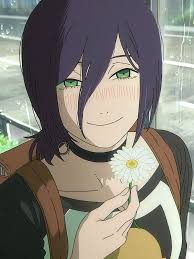
The statements above are reviews of Tatsuki Fujimoto’s Chainsawman: The Movie – Reze Arc, a tragic love story about Denji, a teenager who’s spent the majority of his life without love, and his meeting with the mysterious Reze. While the series’ vulgarity and sexual undertones cause many to write off Chainsawman as a common manga made to draw in hormonal teenagers, Reze Arc serves as the catalyst of Fujimoto’s thesis: “What is love to a boy who lived without knowledge of a heart?”
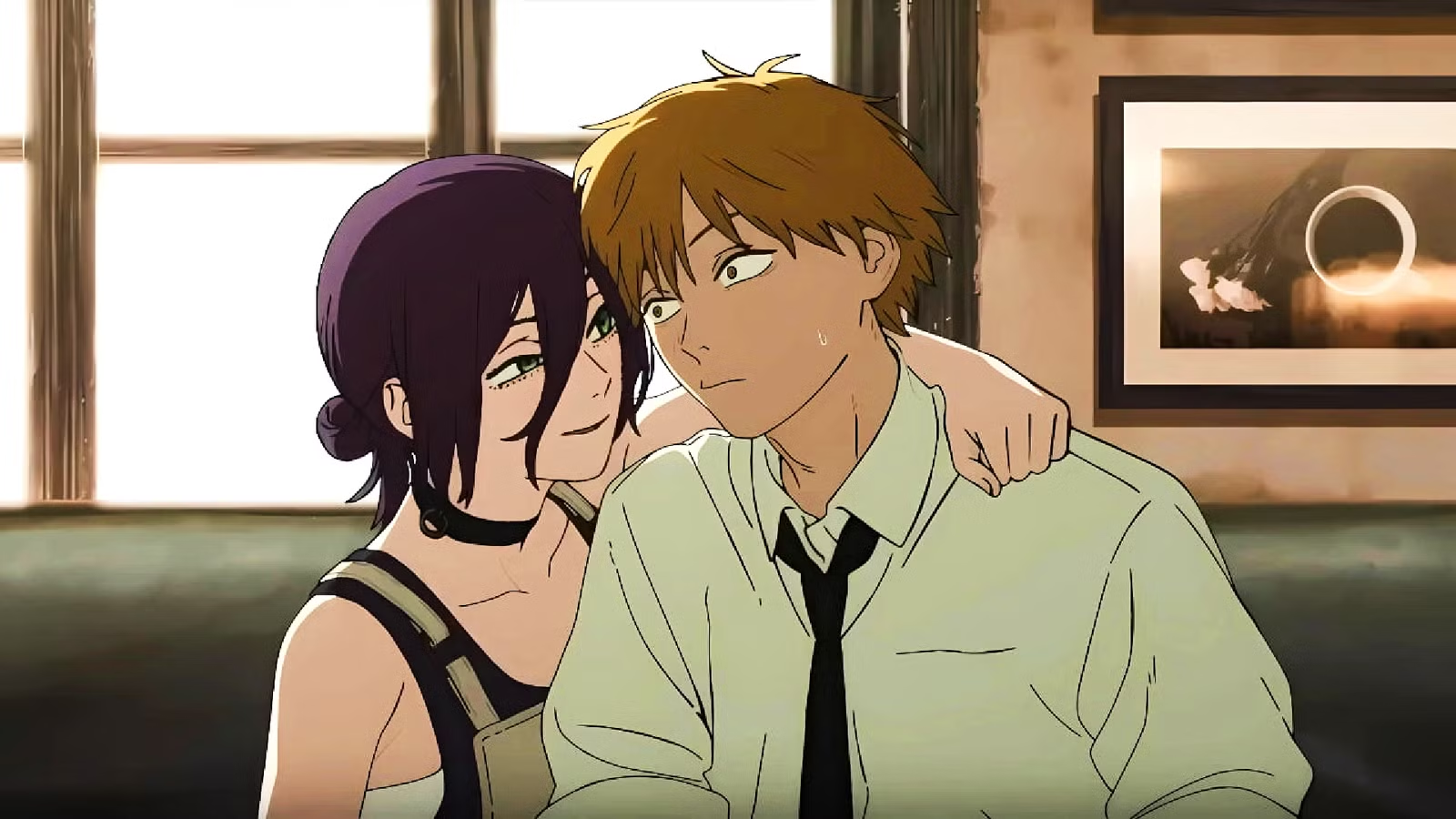
Reze Arc covers the relationship of Denji, a devil-human hybrid able to transform into the titular Chainsawman, and Reze, an enigma of a woman after Denji’s heart. Throughout the film, we see the blossoming romance between the two, and the confusion Denji faces when confronted with the concepts of love and having a heart. The introduction of Reze serves to disillusion Denji from the “normal life” he seems to yearn for, with the hybrid only holding back because of his feelings for Makima, an unnerving figure who keeps all those under her on a tight leash; Kenshi Yonezu’s Iris Out, released and featured as the film’s opening number, serves to mark Denji’s dilemma under the guise of a bombastic club hit. With the lyrics, “No, no, no–morality in my brain screams, ‘stop you idiot,'” and “What on earth do I do with these feelings? What do I do with the hollow under my ribs?” Yonezu encapsulates the conflicting thoughts of Denji, scolding himself for falling in love with someone when his heart “belongs to Makima,” and for not knowing what to even do with the feelings he holds.
A recurring theme of Chainsawman is Denji’s lack of emotional intelligence, meaning that he can’t articulate what he wants or feels at a given time. Where others say “I want to be loved,” Denji says, “I want to touch some boobs,” (yes, that is an actual quote) purely because he was never taught what love is or how it differs from person to person. He confuses physical intimacy with actual love, and is taken advantage of because of this many times during the series. The person who uses this to its maximum being Makima, she promises Denji a normal life, yet restricts what he’s allowed to do, even comparing him to a dog, stating, “I have no use of a dog that says ‘No.'”
Reze calls this out in one of their meetings, stating how strange it is that Denji has never gone to school, with him writing it off as not a big deal. In response, Reze offers to take Denji to her school after hours, which gives us the most beautiful shot of the film.
The scene opens with Reze suggesting that they go swimming in the school’s pool, to which Denji states he never learned how. Reze, however, doesn’t delay, and strips down and starts her swim. Denji is, understandably, caught off guard by the display, and argues with himself that he would be betraying Makima if he were to join Reze. But, before he even realizes, he’s already joining her, diving into the water with no regard for himself whatsoever.
It is then that we get the scene. The camera pans and we see Reze holding her arms out to Denji, a welcoming figure in an unfamiliar environment, as she says, “I’ll teach you! The things you don’t know or can’t do. I’ll teach you everything.” The moment is accompanied by Kensuke Ushio’s in the pool, a beautiful, swelling piano piece that plays as the couple swim. With various shots from Denji’s perspective, with a key detail included or, depending how you’d consider it, missing. Throughout the interaction, Reze is never portrayed in a sexual way, despite being completely nude, even when Denji is the viewer’s source of the moment. This marks a significant shift in Denji’s mind, even when he doesn’t realize it, he’s having so much fun with Reze–the person he loves–that he ignores the ludeness that skinny dipping implies. When remembering the night, he doesn’t see Reze’s body, he sees her giggling as she teaches him how to swim. He sees the kindness she showed him.
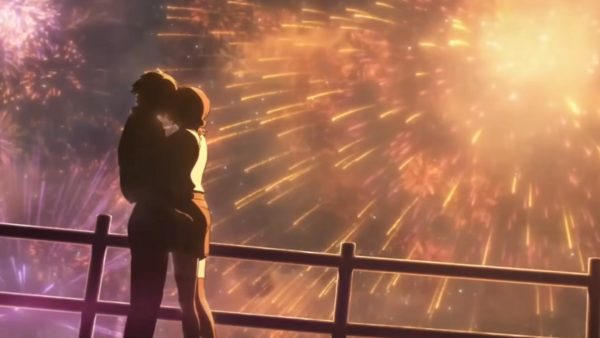
Sadly, nothing lasts forever. The climax of the film reveals Reze as the bomb devil, with her biting Denji’s tongue off in an assassination attempt disguised as a kiss. Throughout their battle, Denji grapples with the realization that everything was fake. Reze a fraud. His heart a facsimile of what others have. His dream a childish endeavor. This brings out a blunt outburst from Denji; not knowing what else to say, he declares, “Everyone’s after my chainsaw-heart. But what about my heart? Denji’s heart! Does nobody want that?” This is one of the first, clear, attempts that Denji has at expressing himself. A call for someone to actually love him, something he’s been robbed of since childhood.
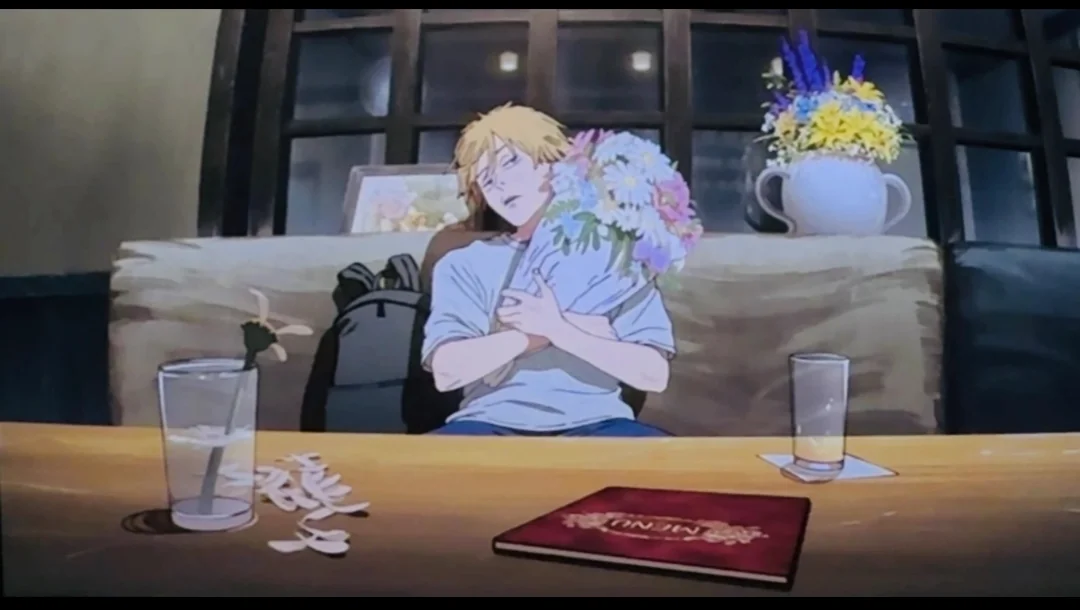
Upon Reze’s defeat, the boy holds out hope, saying that he’ll meet her at the cafe she worked at. Their cafe. Denji refuses the notion that Reze doesn’t care about him, and he puts it all on the line with this declaration. He’ll quit his job and run away, a death sentence for someone like him, all so he can live a happy life with Reze: telling bad jokes, going to festivals, and attending an actual school. The life he dreamed of, but never knew how to accomplish. All that stood between them was a single day.
But that isn’t entirely accurate. Reze never arrives at the cafe, though not for lack of trying. She’s interrupted by Makima, who murders the bomb-hybrid, not standing for the attempt to “steal” Chainsaw away from her. And the movie closes with Reze dying in an alleyway, seeing Denji through the cafe’s window. All he has to do is turn around. Turn around, and he can see her. Save her.
But he doesn’t, and Reze dies without proof she even existed. A Jane Doe.
This happens to be the title of the ending theme that plays as the credits roll, performed by Kenshi Yonezu and Hikaru Utada. A somber ballad reminiscent of Denji and Reze’s brief time together. With Utada’s emotional-yet-restrained voice depicting Reze’s hidden truth, and Yonezu’s more gutteral, raspy tone referencing Denji’s bluntness.
Overall, Chainsawman: The Movie – Reze Arc is a love story between Bomb and Chainsaw; two children who were robbed of their lives and forced to live as weapons, never knowing what a normal life is. If I could ever get the option to see this movie again in theatres for the first time, I would take it without hesitation. This film truly captures everything a motion picture should have by building your feelings up and taking a sledgehammer to your heart.
10/10
melissa • Jan 13, 2026 at 2:56 pm
this is a crazy good review